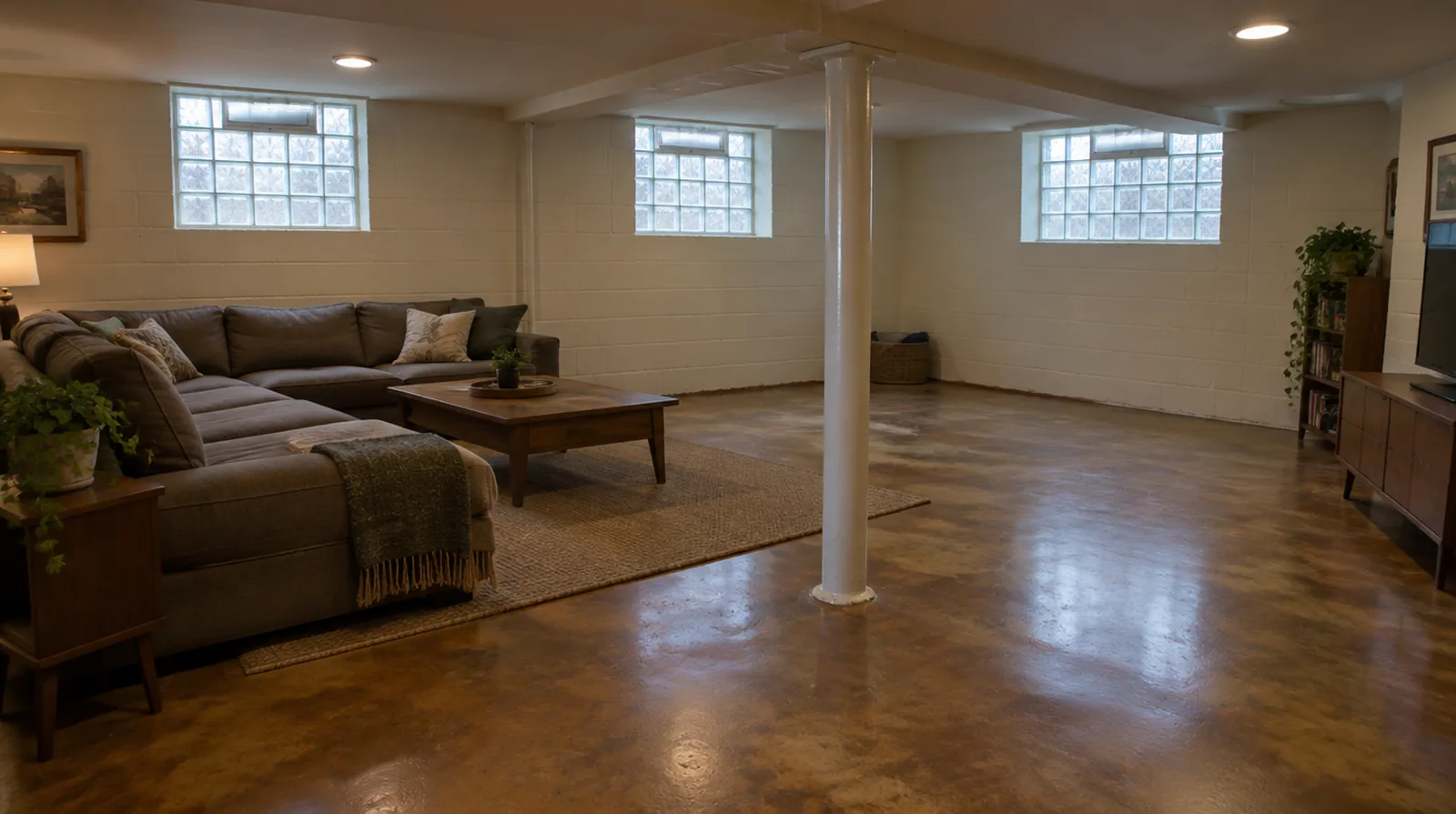
Why stain instead of carpet or paint
Irondequoit basements do a lot of work. They hold the laundry, the furnace, the kids' toys and, more and more, a finished family room. Carpet on a basement slab traps humidity and can smell musty after a wet spring. Floor paint looks fine until it peels at the edges. Stain gets around both problems. It colors the concrete itself, either by reacting with the cement in the case of acid stain or by soaking in pigment in the case of water-based stain, and a clear sealer on top makes the floor easy to mop.
Acid stain gives earthy, mottled tones that look a bit like stone or worn leather. Water-based stain offers more control and a wider palette, from soft grays to near black. We often combine them, using a base color and a second tone to soften old marks.
Built for the houses here
A large share of Irondequoit's homes are capes, colonials and ranches built from the 1920s through the 1960s, with full poured basements. Many of those slabs carry decades of history: tile glue, old paint, outlines of removed walls and patched trenches from drain work. We grind off old finishes first. Patches and lines will still show through the stain, so we help you pick colors that turn them into texture rather than blemishes.
Three-season rooms and sunrooms on the back of the house are another good fit. They often sit on a simple slab that gets cold and dusty. Stain and sealer give them a finished look without the cost of tile, and the floor does not mind the temperature swings of an unheated room.
Moisture comes first
Soils across much of town are sandy and drain well, but homes near the bay, the creeks and the lakeshore can sit on poorly drained ground with a high water table. In spring, when snow melts and the ground is saturated, moisture pushes up through basement floors. Stain itself tolerates that. Thick sealers do not, and they can turn milky or lift if too much vapor is trapped beneath them. Before quoting a basement, we tape plastic to the floor or use a meter to measure moisture. On damp slabs we choose a breathable penetrating sealer. If water is actually coming in, we will tell you to deal with drainage before spending money on a finish.
Outdoor slabs and lake-effect winters
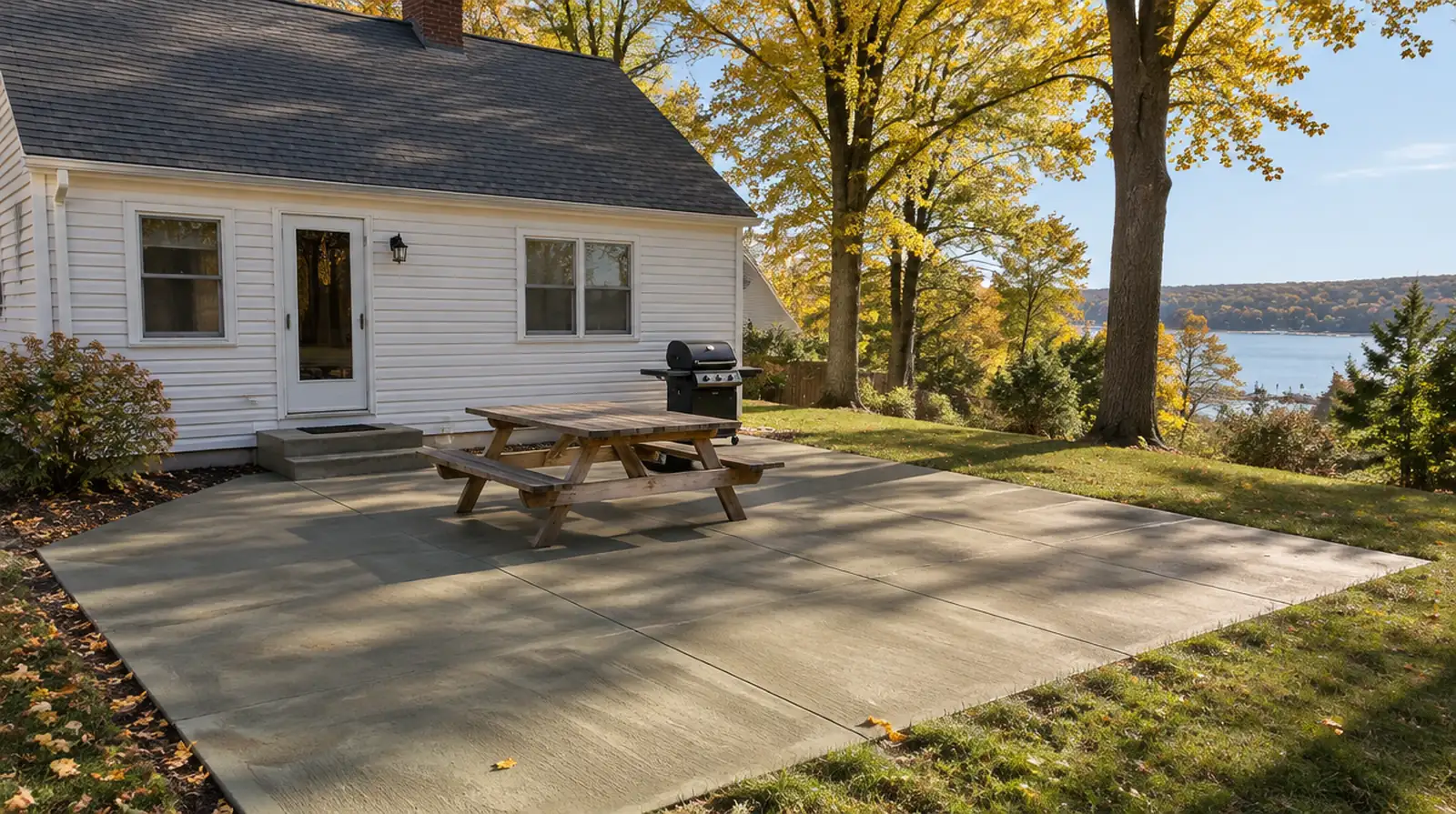
Patios, porches and garage floors can be stained too, but they face a harder test. Lake-effect snow, frequent freeze-thaw cycles and road salt carried in from Culver Road, Titus Avenue and the side streets all wear on sealers. For exterior work we use a sealer designed for freeze-thaw exposure, add a fine anti-slip grit to the final coat and give you a resealing schedule. We stain outside only when it is dry and above about 50 degrees, which in this area means roughly May through September.
What the job looks like
- Visit and test. We check moisture, look for old coatings and stain a small hidden area.
- Prep. Grinding and cleaning bring the floor back to bare concrete.
- Color. Stain is applied in one or two tones. Acid stain is neutralized and rinsed afterward.
- Seal. Two coats, then a cure period before furniture goes back.
Most basement floors take two days from start to finish.
When the slab needs more than stain
Stain highlights flaws instead of hiding them. Pitted, flaking or heaved concrete should be repaired or replaced first. Our concrete repair page explains the options. If you are planning a new patio, ask about pouring it with staining in mind, or compare stain with stamped concrete if you want a pattern too.
Living with a stained floor
Day to day care is simple. Dust mop to remove grit, damp mop with a pH-neutral cleaner and put felt pads under furniture. Rugs are fine once the sealer has cured. In the garage or on the patio, sweep off sand and salt after storms rather than letting slush sit, and rinse the surface when spring arrives.
Questions
Can a stained floor go over radiant heat?
Yes. Stain adds no thickness, so it works well over heated slabs.
How often should it be resealed?
Interior floors every three to five years, exterior slabs every two to three.
Do you cover nearby towns?
Yes, including Rochester, Webster and Penfield.
Find out if your slab is a good fit
Call (585) 684-8773. We will check moisture, look at the surface and do a small stain test before giving you a written price.